Choosing between a sliding gate and a swing gate is one of the most important decisions you’ll make when upgrading your property’s entrance. Both options offer security, automation compatibility, and curb appeal, but the right choice depends on your driveway layout, slope, available space, and long-term goals. A gate that works perfectly on one property can become a daily frustration on another. This guide breaks down the key differences to help you confidently select the best solution for your home or business.
What Is a Swing Gate?
A swing gate operates like a door; it pivots on hinges mounted to sturdy hinge posts and swings open either inward toward the property or outward toward the street. Swing gates can be configured as a single swing gate (one large leaf) or double swing gates (two leaves meeting in the center).
Swing gates typically serve residential properties with openings ranging from 10 to 16 feet wide. You’ll find them at suburban driveways, rural farm entrances, apartment community pedestrian gates, and anywhere a traditional aesthetic fits the setting.
Most municipalities and HOAs restrict outward-opening swing gates because they can swing open into public roads, sidewalks, or parking areas, creating hazards for pedestrians and vehicles. Inward swing is standard for most residential installations.
For automation, an automatic swing gate uses arm operators or underground actuators mounted at the hinge posts. Low-voltage motors and solar-powered gate openers have become common in recent years, making automation accessible even for properties without easy electrical access.
Swing systems work best on relatively flat, even driveways where there’s enough clear space for the full arc of the gate leaves. Slopes and tight spaces can complicate swing operation significantly.
Single vs Double Swing Gates
The same driveway width can be closed with one large leaf or two smaller leaves, and the choice affects cost, space, and long-term durability.
Single swing gates are simpler in hardware and automation. You need one leaf, one set of hinges, and one gate operator. However, a single gate requires full leaf-length clearance behind it. A 12-foot single swing gate needs 12 feet of clear depth to swing open fully.
Double swing gates split the opening into two leaves, each requiring its own hinges, mounting posts, and usually separate operators. The tradeoff: each leaf only needs half the swing distance. That same 12-foot opening now requires roughly 6 feet of clearance on each side.
| Configuration | Hardware | Swing Depth Needed | Best For |
| Single Swing | Simpler, one operator | Full gate width | Wide, open driveways |
| Double Swing | More complex, two operators | Half gate width per side | Tighter spaces, heavy gates |
Double swing systems also distribute all the weight across two posts rather than one, which can improve long-term stability when using heavy steel or solid panel designs. For wider driveway openings above 14 feet, double gates often make more sense structurally.
Space, Slope, and Safety Limits for Swing Gates
Swing gates are more sensitive to driveway slope and obstructions than sliding systems. This is where many homeowners run into trouble after installation.
On an uphill driveway, the bottom edge of a swing gate can scrape the pavement as it opens. Raising the gate creates a gap underneath, a security concern, and an invitation for pets or debris to pass through. Downhill slopes cause similar geometry problems.
Outward swing toward a public road creates safety risks: hitting parked cars, striking pedestrians or cyclists, or blocking a lane of traffic during gate operation. This is why many codes prohibit or restrict this configuration.
Example calculation: A 12-foot inward-swing gate plus a typical 15-foot vehicle requires about 27 feet of clear driveway depth inside the property line before you can safely stop and wait for the gate to swing open fully.
If your property sits on a busy urban street or has a short driveway, check local regulations and clearances carefully before committing to a swing design. The space requirements can be a dealbreaker.
Pros and Cons of Swing Gates
Advantages:
- Generally lower upfront cost than sliding systems
- Simple mechanism with fewer moving parts (hinges and arm operators)
- Classic and elegant appearance suits traditional architecture
- Quieter smooth operation on level driveways
- Easier manual use during power outages, just push the gate open
Drawbacks:
- Requires ample space to swing open fully
- Struggles on steep or uneven sloped driveways
- Solid panels act like sails in windy areas, stressing hinges and posts
- Outward opening often restricted by local codes
- Hinges can sag over time with heavy gate panels
Swing gates are usually the best starting choice for straightforward, flat suburban driveways where cost and aesthetic appeal matter most. They’re proven, reliable, and deliver that estate-style curb appeal many homeowners want.
What Is a Sliding Gate?
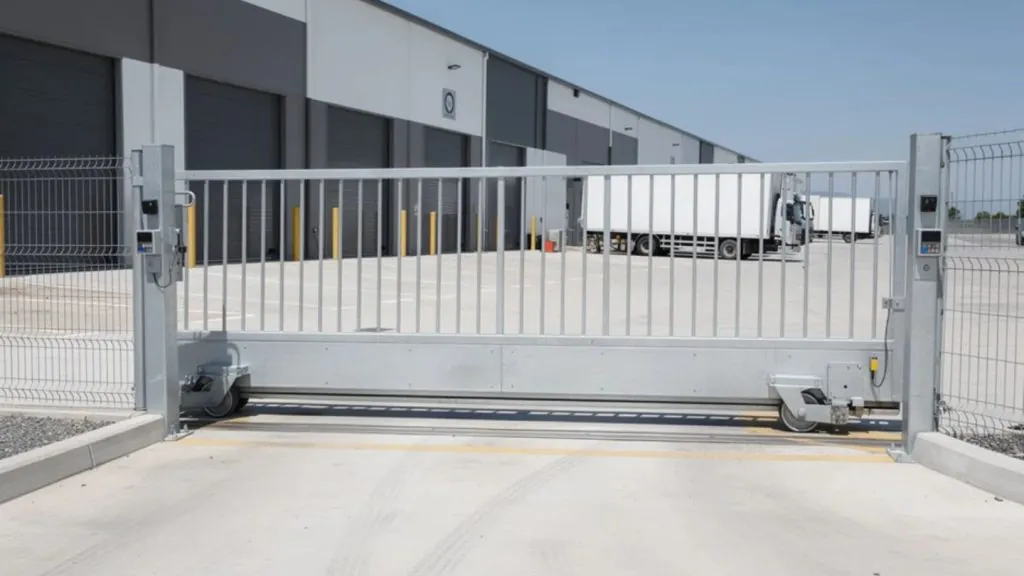
A sliding gate moves horizontally along the fence line rather than swinging on hinges. The gate panel travels on a ground-level track system or uses a cantilever design that suspends the gate without a track crossing the driveway.
When open, a sliding gate tucks behind a boundary wall or fence line, requiring lateral space at least equal to the gate’s width plus 1–2 feet for hardware and clearance. This makes sliding gates space-saving in terms of driveway depth, but they need room along the fence.
Sliding systems dominate commercial properties, storage yards, gated communities, and multi-unit complexes. Industry data shows about 60% of commercial gate installations use sliding systems, rising to 75% in high-security urban sites where space efficiency and traffic flow matter most.
Automation for a sliding gate uses a motor with a gear or chain that engages a rack mounted along the bottom of the gate panel. Gate openers can be controlled by remote controls, keypads, card readers, or integrated access systems, common for commercial properties managing vehicle entry.
Critically, sliding gates work well on driveways that rise or fall because they move parallel to the slope rather than across it. This makes them the default choice for hillside properties and uneven terrain.
Track vs Cantilever Sliding Gates
Two main structural types exist, each suited to different ground conditions and climates.
Tracked sliding gates run on a steel track embedded in concrete across the driveway opening. This track system provides stability and alignment, making it ideal for paved driveways, industrial yards, and stable surfaces. Track maintenance is straightforward but essential; debris, leaves, and ice must be cleared regularly.
Cantilever sliding gates have no track crossing the driveway. Instead, the gate panel is suspended on rollers from a support structure on one side. The gate “floats” across the opening, making this design ideal where snow, gravel, mud, or debris would clog a ground track.
Cantilever systems require a longer gate panel, typically 30–50% longer than the opening width, to accommodate the counterbalanced tail section that provides stability. This means even more lateral space along the fence line.
| Type | Ground Track | Best Climate | Space Requirement |
| Tracked | Yes, concrete-embedded | Dry, stable climates | Gate width + 2 ft |
| Cantilever | No track needed | Snow, rain, and gravel areas | Gate width + 30–50% |
Choose between a track and a cantilever based on local weather conditions and how often heavy vehicles use the entrance.
Space, Slope, and Safety Limits for Sliding Gates
Sliding gates solve many clearance problems swing gates face, but introduce their own constraints.
The key requirement is lateral room along the fence line. For a 14-foot opening, plan on roughly 16 feet of clear run for the gate panel and hardware. This area must stay clear of parked vehicles, planters, utility boxes, mailboxes, and anything else that would block the gate’s path.
Unlike swing gates, sliding systems handle sloped driveways effectively because they move parallel to the incline rather than trying to arc across it. This makes them the go-to choice for hillside properties throughout Georgia and the Southeast.
Modern sliding gate operators include safety features required by current standards: photo-eyes that detect obstructions, edge sensors that reverse the gate if contact occurs, and automatic stop functions. These features protect people, pets, and vehicles from the gate panel during operation.
Pros and Cons of Sliding Gates
Advantages:
- Excellent for tight spaces or sloped driveways where swing gates won’t work
- Enhanced security, linear locking mechanisms are harder to force open than hinged gates
- Less affected by wind since the panel moves along the fence line, not perpendicular to it
- Can accommodate wider driveway openings and heavier panels (up to 2,000 lbs commercial)
- Efficient for frequent daily use with high cycle ratings
Drawbacks:
- Higher installation costs due to track work, concrete, and a more complex mechanism
- Requires precise installation and alignment
- Tracks can collect debris, ice, or gravel, requiring regular track maintenance
- Mandatory lateral space along the fence line, no flexibility here
- Slightly slower open speeds than swing gates in some configurations
For very heavy steel or full-privacy infill panels, sliding gates often provide smoother long-term operation than oversized swing leaves that stress hinges and posts.
Cost Comparison: Sliding Gate vs Swing Gate
Exact prices vary by region, materials, and site conditions, but the relative cost relationships have remained consistent through 2024–2026 projects.
Manual swing gates are generally the least expensive option. Automatic swing gates fall in the middle tier. Sliding systems, whether tracked or cantilever, typically cost the most due to additional concrete work, track installation, and heavier-duty operators.
Key cost drivers include:
- Span width (a 10-foot gate costs less than a 16-foot gate)
- Material choice (aluminum vs steel vs ornamental iron)
- Infill style (open picket designs vs solid privacy panels)
- Automation level (single operator vs dual vs high-cycle commercial motors)
- Site preparation (existing concrete vs new pours, electrical trenching)
Maintenance & Reliability: Living With Your Gate Day to Day
Gates are moving machinery. Low maintenance doesn’t mean no maintenance; both sliding and swing systems need periodic attention to operate reliably for years.
For swing gates:
- Lubricate hinges and pivot points annually (or more often in dusty conditions)
- Check for post movement or gate sag, early signs of structural stress
- Tighten mounting hardware on operators and hinges
- Inspect arm mechanisms for wear, especially on automatic opener systems
For swing gates:
- Keep tracks clear of leaves, stones, ice, and debris; this is critical
- Inspect rollers and racks for wear every 6–12 months
- Ensure the sliding path remains unobstructed (no new planters or parked cars)
- Check that the gate panel moves smoothly without binding or excessive noise
Both gate types need:
- Periodic safety checks on photo-eyes, edge sensors, and stop/reverse functions
- Testing of manual release mechanisms for power outages
- Inspection of wiring, connections, and control boxes
High-cycle commercial entrances with dozens or hundreds of openings per day should plan on scheduled professional maintenance regardless of gate type. Reducing repair costs over the gate’s lifespan starts with consistent upkeep.
Durability in Real-World Conditions
Georgia weather, from coastal storms to summer heat to occasional ice, affects swing and sliding gates differently. Solid panel swing gates in windy areas behave like sails. Wind loads exceeding 50 mph put high stress on hinges and posts, potentially causing misalignment or hardware failure over time. Sliding gates hug the fence line and withstand winds up to 80 mph more effectively because they don’t catch wind the same way.
In areas with snow or heavy rain, tracked sliding gates need proper drainage design to prevent water pooling and ice buildup in the track. Cantilever systems avoid this problem entirely by eliminating the ground track.
Quality of installation matters more than gate type for long-term reliability. Correct concrete depth, proper post setting, and appropriate motor mounting determine whether your gate operates smoothly for 5 years or 20 years. Cut corners during installation, and you’ll pay for it in ongoing repairs. Budget for at least an annual inspection in harsher climates or for busy commercial sites with constant traffic flow.
Design, Aesthetics, and Property Value

Your gate creates the first impression of your property. It’s the first thing visitors, delivery drivers, and potential buyers see, and it affects both curb appeal and perceived property value.
Swing gates carry traditional, estate-style associations. Double swing designs that open gracefully from the center evoke classic elegance, making them popular for upscale residential properties and historic neighborhoods. That elegant appearance translates to higher overall curb appeal in the right setting.
Sliding gates read as modern appeal, sleek, efficient, and contemporary. They blend into long fence lines and complement modern architectural styles with clean lines and minimal ornamentation. For commercial properties, sliding gates project professionalism and enhanced security.
Common materials work across both configurations:
- Powder-coated aluminum (lightweight, rust-resistant)
- Galvanized steel (strong, durable, ideal for Georgia weather)
- Timber cladding on steel frames (warm residential aesthetic)
- Ornamental iron (traditional elegance, requires more maintenance)
Consider visibility needs: open picket designs maintain sightlines and airflow, while solid infill provides privacy and noise reduction. This choice affects aesthetics, security, and even how the gate handles wind, regardless of whether it slides or swings.
Matching Gate Type to Property Type
Different properties have different priorities. Here’s practical guidance for common scenarios:
Single-family homes: Choose based on driveway slope, available depth, and neighborhood character. A traditional streetscape with colonial or craftsman homes typically suits swing gates. Modern or contemporary architecture pairs well with clean-lined sliding systems.
Multi-unit residences and HOAs: Sliding gates handle steady car traffic better with consistent, predictable gate operation. Integrated access control (cards, fobs, apps) works seamlessly with sliding operators. Space efficiency at shared entrances matters when multiple vehicles queue during peak hours.
Small businesses and light commercial: Sliding gates pair naturally with security fencing, surveillance systems, and scheduled delivery windows. The durability under frequent cycling and resistance to forced entry make them practical for facilities prioritizing security needs.
Rural and agricultural properties: Wide openings often favor sliding or double swing gates. Consider dust, gravel, and equipment access, cantilever sliding systems avoid track clogging from farm debris.
Whatever you choose, harmonize the gate with existing fence lines, mailbox placement, landscape lighting, and overall property aesthetics for a cohesive, intentional look.
Final Thoughts
Choosing between a sliding gate and a swing gate ultimately comes down to space, slope, wind exposure, budget, and how frequently your gate will operate. Swing gates offer classic style and lower upfront costs for flat, open driveways, while sliding gates excel in tight spaces, sloped properties, and high-traffic entrances. Both options can be automated with modern safety and access control features. By carefully measuring your layout and evaluating daily use needs, you can select a gate system that delivers reliable operation, security, and lasting property value.
For expert guidance, trust Georgia Gate & Fence, your trusted residential gate supplier in Cumming, which the homeowners rely on for quality and durability. Whether you’re considering elegant swing gates or space-saving sliding gates, our team provides professional design, installation, and automation solutions tailored to your property. Visit us to schedule a consultation and build an entrance that combines security, performance, and curb appeal.
Frequently asked questions
Conversion is possible, but usually treated as a new installation. Sliding systems require new framing, posts, track, or cantilever hardware, and possibly concrete work. Adequate fence-line space is essential. A professional site evaluation determines feasibility and cost.
Both swing and sliding gates are safe when equipped with photo-eyes, safety edges, and UL325-compliant operators. Swing gates near sidewalks or play areas require careful design. Keep controls out of children’s reach and reinforce gate safety rules.
Many municipalities and HOAs require approval for driveway gates, especially those facing public roads. Height limits, swing direction, motor placement, and visual impact are commonly reviewed. Confirm regulations early to avoid costly redesigns or compliance issues.
Most automatic gates include a manual release mechanism that allows hand operation during outages. Optional battery backups or solar systems can maintain function temporarily. Learn and test the manual release periodically to ensure reliable access in emergencies.
A properly installed gate structure can last 15–20 years or more with regular maintenance. Operators typically require service or replacement every 8–15 years, depending on usage frequency. Routine inspections and lubrication significantly extend overall system lifespan.